6
The modern American sports broadcast is virtually unrecognizable from its counterpart just a decade ago. Where commercial breaks were once dominated exclusively by automotive brands, beer companies, and fast-food chains, a new titan has taken over the advertising inventory: the sports betting industry. Following the repeal of federal restrictions on sports wagering, a multi-billion-dollar gold rush commenced. To capture market share in this rapidly expanding ecosystem, betting operators have unleashed some of the most aggressive, sophisticated, and omnipresent marketing campaigns in modern advertising history.
However, the sheer volume of these advertisements only tells part of the story. The true power of gambling marketing lies in its psychological architecture. These campaigns are not simply announcing the existence of a product; they are actively reshaping how the public perceives risk, altering the foundational experience of sports fandom, and systematically dismantling traditional consumer hesitations. By examining the underlying mechanics of these advertisements, we can understand exactly how they influence consumer awareness and drive financial decisions.
From Taboo to Mainstream: Normalizing the Wager
For generations, sports betting existed on the periphery of American culture. It was an activity relegated to Las Vegas casinos, offshore websites, or local bookmakers. The primary achievement of the current wave of gambling advertising has been the total normalization of the activity.
By purchasing premium airtime during prime-time NFL games, sponsoring massive stadium naming rights, and integrating their brands directly into pre-game broadcast desks, sportsbooks have successfully aligned themselves with the wholesome, culturally unifying tradition of American sports. The messaging subtly suggests that placing a wager is not a fringe vice, but rather an essential, expected component of being a true fan. This omnipresence strips away the historical stigma associated with gambling. When a consumer sees a betting app logo displayed next to the score bug of a Sunday afternoon football game, their subconscious immediately registers the activity as safe, sanctioned, and entirely normal.
The Celebrity Endorsement Halo
To further accelerate this normalization, gambling operators heavily rely on the halo effect of celebrity endorsements. Advertisements frequently feature beloved comedians, A-list actors, and legendary retired athletes. This is a highly calculated psychological maneuver. Consumers naturally harbor a baseline level of skepticism toward casinos and betting operators. However, when a trusted, familiar face tells them to download an app and place a bet, that skepticism evaporates. The celebrity acts as a bridge of trust, transferring their personal credibility to the betting platform and making the consumer feel as though they are joining an exclusive, high-status club rather than simply risking their hard-earned money.
The Illusion of Control and the Skill Narrative
One of the most potent ways gambling advertising influences consumer decisions is by fundamentally reframing the nature of the activity. Casino games like roulette or slot machines are universally understood to be games of pure chance. Sports betting, however, involves real-world events, statistics, and human performance. Advertisers ruthlessly exploit this distinction to create an illusion of control.
Commercials rarely focus on the inherent unpredictability of sports. Instead, they flatter the viewer’s intelligence. The messaging is built around phrases that emphasize knowledge and strategy, urging consumers to put their sports IQ to the test, build the perfect parlay, or capitalize on their gut instincts. By framing a bet as a calculated investment rather than a blind gamble, advertisers neutralize the consumer’s fear of losing. The psychological implication is clear: if you lose a bet, it was not because the game was rigged or the odds were mathematically against you; it was simply because you did not analyze the stats closely enough. This narrative transforms the consumer from a passive participant relying on luck into an active strategist, making them highly susceptible to placing repeated wagers to prove their expertise.
Frictionless Entry: The Psychology of the Promotional Offer
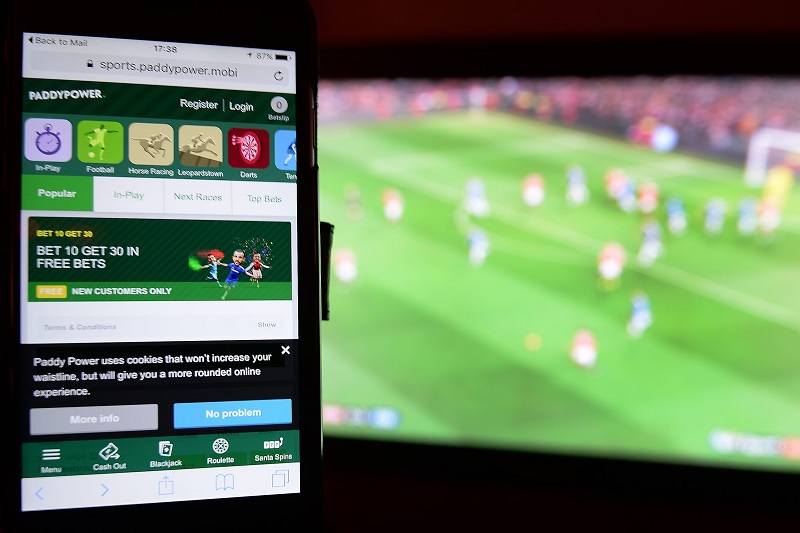
Even with normalized messaging and celebrity endorsements, asking a consumer to link their bank account and risk their own money is a significant hurdle. To overcome this final barrier to entry, gambling advertising relies on the heavy promotion of introductory offers designed to exploit basic behavioral economics.
The cornerstone of this strategy is the “risk-free” bet or the “deposit match.” Human beings are naturally wired with loss aversion, meaning the psychological pain of losing money is far more intense than the pleasure of winning the same amount. Advertisers bypass this defense mechanism by temporarily removing the perceived risk. When an ad promises that a new user will receive their money back in site credit if their first bet loses, the consumer’s internal risk assessment is short-circuited. The decision to download the app is no longer viewed as a financial risk, but rather as a mathematically logical attempt to capture free value.
Once the consumer crosses this threshold and downloads the application, the operator has won the most important battle. The friction of having to drive to a physical casino has been permanently eliminated; the casino is now residing in the consumer’s pocket, ready to be accessed at a moment’s notice.
In-Play Advertising and the Acceleration of Impulse
Traditional sports betting required a consumer to place their wager before the game began. They would then sit back and watch the event unfold over several hours. Modern gambling advertising has completely dismantled this slow-paced consumption model by heavily promoting in-play, or live, micro-betting.
During commercial breaks, or even read live by commentators during the broadcast, consumers are bombarded with dynamically updating odds. They are prompted to bet on the outcome of the very next drive, the next pitch, or the next free throw. This style of advertising is designed to trigger immediate, impulsive decision-making. It preys on the fear of missing out (FOMO) and the human brain’s craving for instant gratification. By shrinking the feedback loop between placing a bet and seeing the result from three hours to three minutes, these advertisements keep the consumer in a constant state of heightened emotional arousal, making them far more likely to chase losses or place irrational bets in the heat of the moment.
Algorithmic Targeting and the Digital Echo Chamber
While television commercials provide the broad cultural normalization, the true precision of gambling advertising occurs in the digital realm. Sports betting operators possess some of the most sophisticated data-tracking and algorithmic targeting capabilities in the marketing world.
If a consumer watches sports highlights on social media, listens to a fantasy football podcast, or searches for a team’s injury report, their digital footprint immediately flags them as a prime target. From that moment on, they are shadowed by highly personalized gambling advertisements across every digital platform they visit. This creates a powerful echo chamber. A consumer might receive a push notification offering a boosted payout on their favorite team just hours before kickoff, precisely when their emotional investment in the upcoming game is at its peak. This relentless, data-driven targeting ensures that the temptation to wager is not just omnipresent, but specifically timed to intercept the consumer when their resistance is lowest.
The Hidden Cost of Gamification
Finally, it is crucial to recognize how the visual language of gambling advertising influences consumer behavior, particularly among younger demographics. The commercials and the betting interfaces themselves are heavily gamified. They utilize bright colors, dynamic animations, and progress bars that closely mimic the aesthetics of popular video games.
This gamification serves a very specific purpose: it distances the consumer from the reality that they are spending actual fiat currency. When a bet is placed, the interface often responds with celebratory digital confetti or unlocking achievements, triggering the same dopamine release associated with leveling up in a mobile game. This visual conditioning softens the psychological blow of losing money and continuously reinforces the idea that sports betting is primarily a harmless, interactive entertainment product rather than a serious financial transaction.
Navigating the New Reality of Sports Consumption
The widespread integration of gambling advertising has fundamentally altered the American sports landscape. These marketing campaigns are masterclasses in consumer psychology, blending cultural normalization, the illusion of skill, frictionless onboarding, and algorithmic precision to turn passive viewers into active bettors.
As the industry continues to grow and innovate its marketing strategies, consumer awareness becomes the most critical defense. Recognizing the psychological triggers embedded in these advertisements—from the deployment of trusted celebrities to the careful phrasing of promotional offers—allows individuals to step back and evaluate their decisions rationally. Sports betting can undoubtedly exist as a form of adult entertainment, but only when consumers understand that they are playing against a house that has already calculated every possible angle, starting with the very commercial that convinced them to place the bet.
